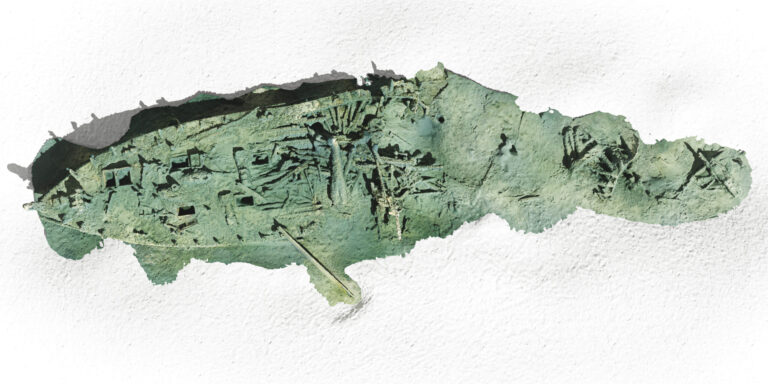
Every time we post a fly-through of Maria Concordia or Marie Agnes, someone asks the same question: “How did you make the scan move like that?”
It’s a fair question. A raw photogrammetry scan is just a static mesh – millions of triangles, no story. Turning it into the kind of cinematic animation you see on this site is a separate craft, one I built up over years of Blender work long before I ever pointed a camera at a flooded mine.
What I didn’t have, for a long time, was a way to hand that skill to the divers around me. Most of them could run a dive and shoot a survey better than I ever will – but had never opened Blender in their lives. Every general animation tutorial online assumes you’re rigging a game character or lighting a film set, not fighting backscatter and coded targets from a Metashape export.
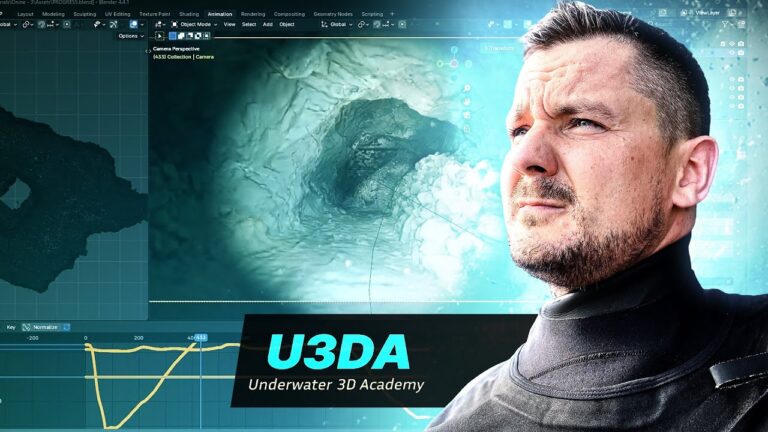
So I built Underwater 3D Academy (U3DA) to teach the exact pipeline I use on Foundation expeditions, from scratch, to people who’ve never touched a 3D program.
It’s a course: but that undersells it
U3DA teaches divers how to take a scan out of Metashape or RealityCapture and bring it to life in Blender: cinematic lighting and camera work, the wireframe-to-solid reveal you’ve seen in our own videos, full fly-throughs of caves, mines and wrecks, compositing, and even the animated minimaps that make a viewer understand where they are inside a flooded system.
Six lessons, built directly from the pipeline behind real Foundation expeditions – not a generic 3D course with underwater footage bolted on.
Learn more on www.u3da.pl